


The 4 Biggest Mistakes in Disinfection
Many companies follow cleaning protocols yet still encounter recurring bacterial counts or persistent biofilm. This often comes from a fundamental imbalance in the cleaning process, which can be seen through the Sinner’s Circle.
What is the Sinner’s circle?
The Sinner’s Circle shows that an effective cleaning process relies on four variables. To maintain a consistent result, a reduction in one factor typically requires compensation from another. [1]
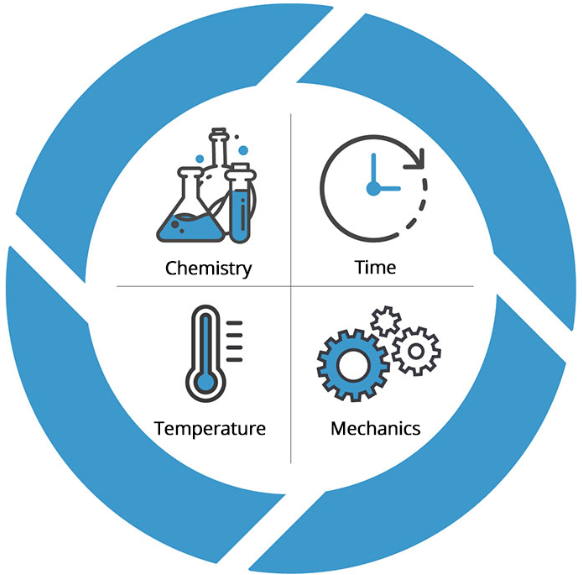
Figure 1: The Sinner’s Circle: The four pillars of a balanced cleaning process. [2]
The four factors are:
- Chemicals: The cleaning agent or biocide.
- Time: The contact or dwell time.
- Temperature: The thermal energy of the solution.
- Mechanical Action: Physical force, pressure, or flow
4 Common mistakes: why the circle breaks
1. The chemistry mistake: The "chemical shock" fallacy
Many facilities try to kill germs by using large, occasional doses of bleach. This backfires because the germs learn to survive these hits, creating tougher bacteria that are much harder to wash away. Instead of a clean system, you end up with a slime layer that resists normal cleaning [3]
2. The time mistake: neglecting contact time
Disinfectants need time to work. A common error is too little contact time.If the disinfectant is washed away too fast, it can't get past the germ's outer shell. This lets the strongest bacteria survive and spread even faster. [4].
3. The mechanics mistake: The "biofilm" blind spot
Bacteria often hide inside a sticky "slime" called biofilm. Standard cleaning usually only hits the surface layer. Without continuous or the right mechanical pressure, the bacteria are not fully removed; giving biofilm the chance to develop
4.The temperature mistake: The "temperature trap"
Relying on extreme heat to kill bacteria is resource-intensive and often impossible in large, complex piping systems. This creates "cold spots" where bacteria thrive. Using high heat or thermal energy to fix a weak cleaning process costs too much energy and fails to produce the desired results. [6]
How Watter balances your cleaning circle
The Watter System produces Hypochlorous Acid (HOCl) on-site through the electrolysis of water and salt. This process changes how the Sinner’s Circle is balanced:
- Effective penetration: Germs hide in a slimy layer that shields away normal bleach, but our uncharged solution slips right through to kill them where they hide. This provides a thorough clean without relying on high-concentration shocks.[7]
- Continuous biofilm control: Instead of relying solely on periodic "shocks" (which can leave gaps for regrowth), Watter maintains a continuous, low-level presence in the system therefore enhancing the control. This constant protection effectively targets bacteria within biofilms that can often survive the intervals between standard cleaning cycles. [8]
- Logistical advantages & sustainable process: Producing the solution in-situ from just water, salt, and electricity reduces the need for transporting and storing concentrated chemicals.
- On-Site production: You no longer have to buy, move, or store heavy jugs of chemicals. Since it is effective at room temperature, it reduces the need for thermal energy compared to heating thousands of gallons of water.
Why standard disinfection fails (and how Watter solves it)
Most cleaning mistakes happen because traditional methods can't stay consistent. Here is how the Watter System overcomes those limits:
|
Factor |
Traditional Cleaning |
The Watter System |
|
Chemicals |
Uses high-concentration dosing that germs can sometimes resist. |
Uses HOCl designed to penetrate protective layers. |
|
Temperature |
Often requires high thermal energy to work well. |
Effective at room temperature. |
|
Biofilm |
Only cleans the surface during scheduled breaks. |
Always running, preventing slime from establishing. |
|
Consistency |
Relies on people and schedules, leading to human error. |
Fully automatic, giving you continuous desinfection every single day. |
Conclusion: balancing the circle with Watter
Effective hygiene isn't about using the most aggressive chemicals; it’s about keeping the Sinner’s Circle in balance. Traditional cleaning often fails because it relies on manual fixes and "shocks" of heat or chemicals that only work for a moment.
The Watter system changes this by providing continuous disinfection that protects your pipes Continuously. By making your own disinfectant on-site, you move away from irregular "spikes" in cleaning and switch to a consistent process that helps you keep a good microbial balance and lower the risk of production stops.
Stop fighting biofilm with temporary fixes
Are you tired of biofilms that keep coming back even when you clean It’s time to move from just cleaning to a continuous disinfectant against biofilm
Let's build your custom disinfection plan and see how Watter keeps you protected 24/7.
Ready for a cleaner workspace?